
Technical methods and scope
Define the AI evidence question before choosing a detector
AI forensics can address synthetic or altered media, disputed model activity, prompt and output history, retrieval sources, agent actions and model-related intellectual property. These are different evidence problems. A media-authentication question calls for original files and recording history. A model-behavior question calls for versions, configuration, prompts, logs and reproducible tests. The engagement begins by identifying which claim can actually be tested.
A detector score is not a conclusion. Compression, transcoding, screen recording, ordinary editing and platform processing can create artifacts that resemble generation or manipulation. Conversely, a generated file may lose model-related traces after export or recompression. Findings should combine independent observations and state confidence, alternatives and material gaps.
Synthetic and altered media examination
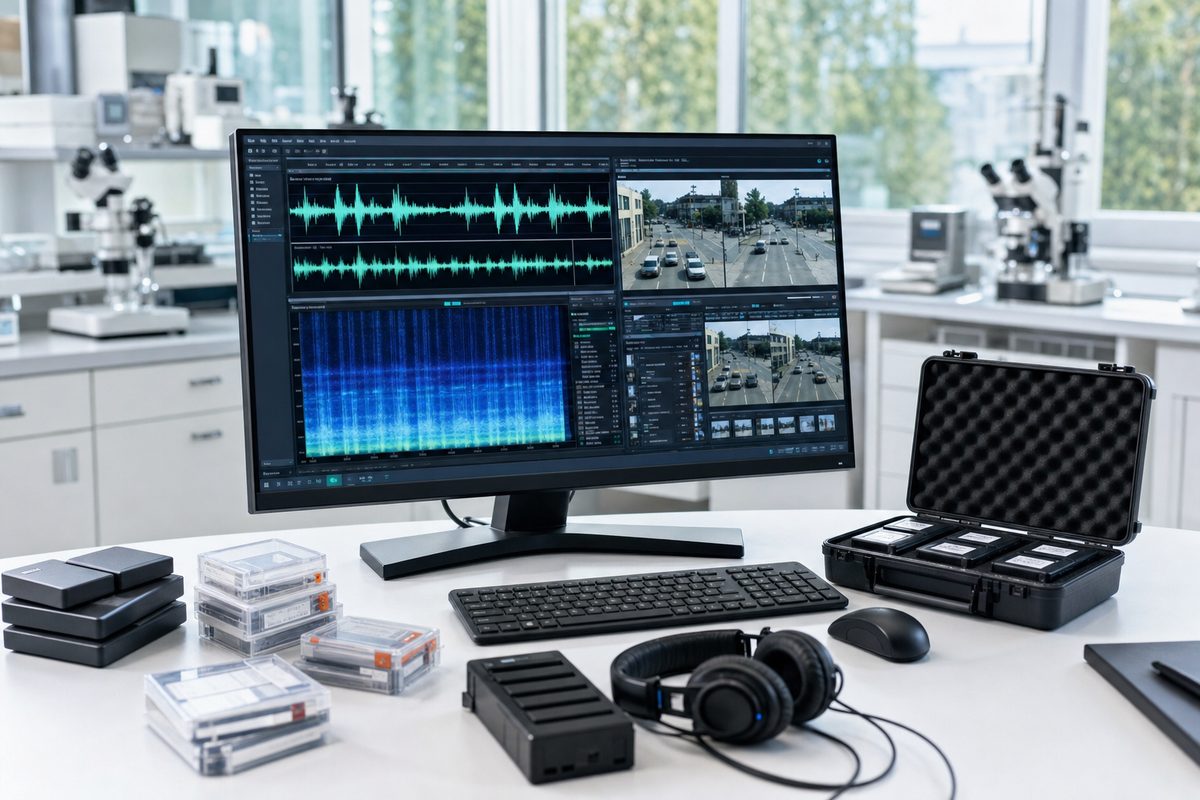
The preferred starting point is the earliest available file, not a social-media download or messaging preview. The examiner records container and codec structure, metadata, edit history when present, frame timing, compression patterns, audio continuity and the relationship between image and sound. Reference recordings, device records, cloud originals and publication history can be more probative than a single pixel-level anomaly.
Video work may examine inter-frame consistency, lighting and geometry, face and mouth behavior, audio-video synchronization and encoding changes. Audio work may examine waveform continuity, spectral behavior, room sound, edits and speaker-comparison features when adequate exemplars exist. Still-image work may examine metadata, resampling, compositing boundaries, sensor-related patterns and provenance records. No single artifact establishes whether content is authentic.
Model, application and agent records
When the disputed event occurred inside an AI application, the relevant boundary extends beyond the model. Evidence may include system and developer instructions, user prompts, outputs, model and application versions, retrieval results, tool calls, identity records, content filters, rate limits and downstream actions. A reconstruction should account for which records are provider-controlled, which are customer-controlled and which were never logged.
Controlled testing uses the preserved configuration or the closest documented replica. Repeated runs help distinguish deterministic application behavior from sampling variation. Tests record inputs, parameters, environment, time, outputs and observed side effects. Claims about intent, authorship or policy compliance remain separate from the technical observations.
Training data, provenance and intellectual property
Where the actual model, data and authorized access permit, an agreed empirical test can evaluate specified observed behavior. It does not prove membership in unseen training data or reveal a model's internal reasoning. Record test assumptions, unavailable evidence and specialist requirements.
A report built around reproducible observations
The final record can include a source inventory, preservation log, media or system timeline, reproducible test cases, comparison exhibits and a technical report. Methods are selected for the source and question, then explained with their error risks and limits. Legal, regulatory and authorship conclusions remain with the responsible decision-maker.