
Media evidence
Audio, Video & Image Authentication
Is the recording, photograph or video what it claims to be? GDF examines the original files and supporting records, then explains the findings in a clear report and expert testimony when needed.
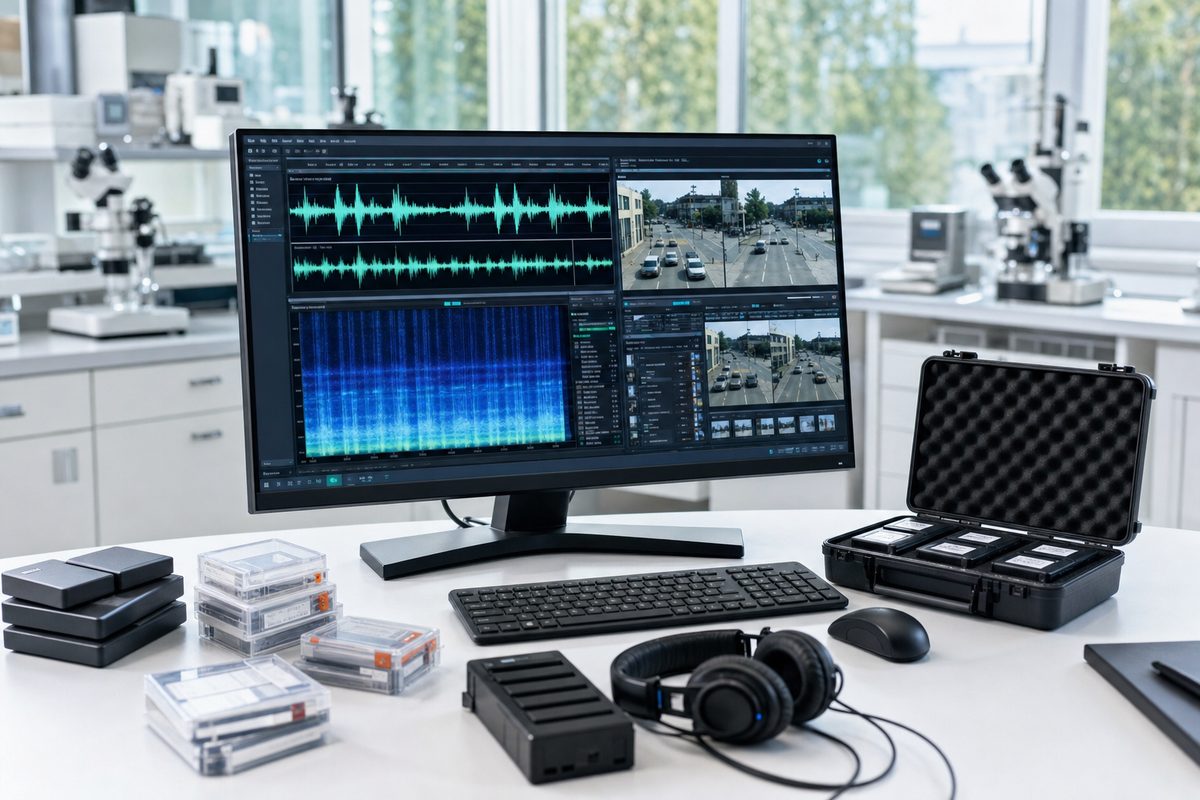
Agree the authenticity question and examination method
This service concerns the authenticity and interpretation of ordinary or synthetic recordings and images. Scope original files, capture/export devices, available independent copies, alleged alteration and suitable comparison material; compressed reposts may limit conclusions.
Confirm the relevant audio, image or video examiner and method-specific qualifications. The report distinguishes container and codec observations, sequence or waveform comparisons, supported manipulation findings and unresolved alternatives.
A model/application evidence question uses the AI Forensics service; a specialized synthetic-media question can use Deepfake Detection & Authentication. A general detector score or signed provenance record is not proof of scene truth.
Primary references: NIST forensic methods review (opens in a new tab) · C2PA provenance explanation (opens in a new tab).
The engagement
Start with the original file and its history
Media can be transcoded, edited, screen-recorded, forwarded, enhanced or generated. Each transformation changes the available evidence, and ordinary processing can resemble manipulation when context is ignored.
GDF examines containers, codecs, metadata, frame or waveform behavior, device and platform context, and available source records. Conclusions use explicit confidence language and distinguish evidence of editing from evidence of deceptive fabrication.
Scope
File and metadata examination
Container, codec, timestamp, stream and embedded metadata assessed for consistency and provenance clues.
Video examination
Frame structure, timing, motion, encoding and visual discontinuities reviewed in context.
Audio examination
Waveform, spectral, timing, background and encoding characteristics assessed for edits or synthesis indicators.
Image examination
Pixel, compression, metadata and scene-level observations assessed against the claimed source.
Synthetic-media analysis
Multiple technical and contextual methods used without treating a model score as a verdict.
Source and platform correlation
Comparison with original devices, cloud records, message exports or publication history where available.
Methodology
How the examination works
-
Preserve
Obtain the highest-fidelity available source and record every transformation already known.
-
Characterize
Identify file structure, streams, codecs, metadata and expected device or platform behavior.
-
Test
Apply complementary media, signal and provenance analyses; compare alternative explanations.
-
Conclude
State what is supported, what is inconsistent and what remains indeterminate using calibrated language.
Evidence commonly examined
Evidence reviewed
- Original and derivative media files
- Source devices and application exports
- Container, codec and metadata records
- Frames, waveforms and spectral features
- Platform and message provenance
- Reference recordings or imagery
What you can expect
What you receive
- Media evidence inventory and provenance map
- Documented examination workflow
- Annotated technical findings
- Expert opinion, exhibits and testimony support
Frequently asked
Common questions
Can an AI detector prove a video is fake?
No single detector score should be treated as proof. Reliable examination uses multiple technical methods, provenance and case context.
Can you work from a social-media copy?
Yes, but recompression and metadata stripping may limit the conclusion. Obtaining the original file or source device can materially improve the analysis.
Does evidence of editing mean fraud?
No. Cropping, transcoding, enhancement and platform processing can all change a file. Intent is a separate question and may require other evidence.
Talk with an examiner
Discuss your matter and next step
Tell us the systems, evidence and deadline. We can review relevant experience, potential conflicts and the scope before engagement.
Since 1992 · 24/7 dispatch · Court-tested experts
Talk with an examiner
Discuss the matter and the next step.
Tell us what happened and what you need to find out. Speak with a GDF expert about how we can help.
24/7 hotline: 1-800-868-8189